PID feedback control
A proportional–integral–derivative controller (PID controller) is a control loop feedback mechanism control technique widely used in control systems.
A PID controller continuously calculates an error value as the difference between a desired setpoint and a measured process variable and applies a correction based on proportional, integral, and derivative terms. PID is an initialism for Proportional-Integral-Derivative, referring to the three terms operating on the error signal to produce a control signal.
The theoretical understanding and application dates from the 1920s, and they are implemented in nearly all analogue control systems; originally in mechanical controllers, and then using discrete electronics and latterly in industrial process computers. The PID controller is probably the most-used feedback control design.
Referring to the equation below;
If u(t) is the control signal sent to the system, y(t) is the measured output and r(t) is the desired output, and tracking error , a PID controller has the general form


The desired closed loop dynamics is obtained by adjusting the three parameters , and , often iteratively by "tuning" and without specific knowledge of a plant model. Stability can often be ensured using only the proportional term. The integral term permits the rejection of a step disturbance (often a striking specification in process control). The derivative term is used to provide damping or shaping of the response. PID controllers are the most well established class of control systems: however, they cannot be used in several more complicated cases, especially if MIMO systems are considered.


Applying Laplace transformation results in the transformed PID controller equation


with the PID controller transfer function

There exists a nice example of the closed-loop system discussed above. If we take
PID controller transfer function in series form

1st order filter in feedback loop
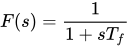
linear actuator with filtered input
- , A = const
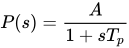
and insert all this into expression for closed-loop transfer function H(s), then tuning is very easy: simply put
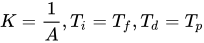
and get H(s) = 1 identically.
For practical PID controllers, a pure differentiator is neither physically realisable nor desirable due to amplification of noise and resonant modes in the system. Therefore, a phase-lead compensator type approach is used instead, or a differentiator with low-pass roll-off.

Comments
Post a Comment